Woodknowledge Wales is pleased to present the Local Timber Supply Chain Review: the findings of a detailed survey and interview programme with small sawmillers across Wales.
This report examines who is operating in the sector, at what scale, under what conditions, and with what prospects, covering sawmill capability, constraints, financial performance, expansion and reinvestment.
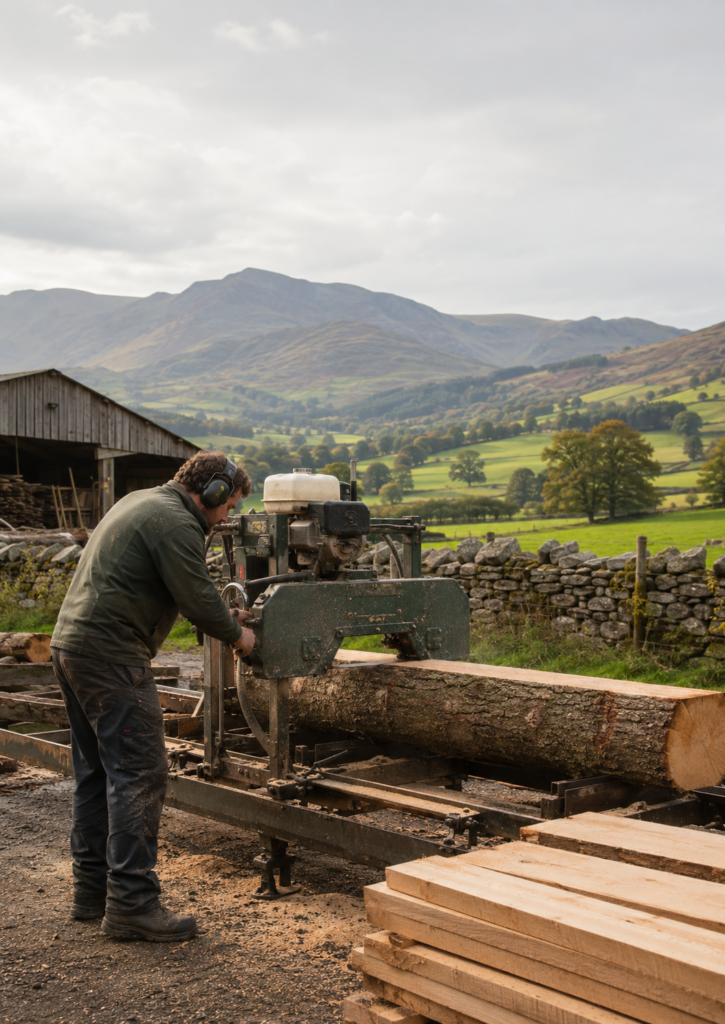
The work was commissioned to provide Welsh Government with a clearer evidence base on local timber supply chains, focusing on small-scale processing capacity, timber availability, sales and movement, and the practical conditions needed to strengthen the sector.
Individually, many of these businesses are modest in scale. Collectively, however, they perform an enabling role within the Welsh timber economy. They provide routes for timber from farms, estates, small woodlands, arboriculture, and local forestry work to be processed and used, often in ways that larger systems are not configured to support. Their value is therefore not only in the direct employment they provide, but in the wider activity they make possible: woodland management, local building and repair work, rural enterprise, and the everyday circulation of materials, skills, and income within local economies.
The sector is highly varied; there is no typical Welsh small sawmill. Businesses range from occasional, micro-scale operations processing a few tonnes a year, to more structured mid-scale processors running near-continuously with invested infrastructure. Most are not standalone sawmilling businesses, and sawmilling is integrated into wider livelihoods that may include fencing, farming, forestry contracting, arboriculture, joinery, firewood, social enterprise and training. This diversity is not incidental. It is a defining feature of the sector, and it matters for how support and policy are designed.
Download the review from here.
To help navigate this heterogeneity, the report identifies five broad, indicative business types:
- Micro operators
- Integrated land-based businesses
- Mid-scale processors
- Specialist and niche producers
- Emerging and transitional businesses
These are not rigid categories. Many businesses sit across more than one type, and circumstances change. But the typology helps explain why constraints, opportunities, and support needs vary so significantly across the sector.
Download the review from here.
