We are pleased to announce a new project investigating the resilience of Welsh timber supply chains and exploring technical, social, economic and policy innovations that can help Wales derive greater value from Welsh-grown timber while building a stronger, more adaptable and self-reliant supply chain.
The Project – This Welsh Government contract seeks to strengthen the Welsh timber supply chain by expanding it from a commodity-oriented model toward innovation-led uses to support construction, decarbonisation and economic resilience. Key challenges identified include misalignment between forest resources and end-use needs, processing infrastructure optimised for commodity markets (pallets, fencing), limited specifier confidence in home-grown timber, fragmentation among SME sawmills, poor supply intelligence, and vulnerability to global market shocks. The work is expected to deliver practical, implementable outcomes that increase the value derived from Welsh timber, improve data and resilience, and better equip SMEs to supply construction markets, including social housing initiatives such as Tai ar y Cyd.
We position the project as a strategic, whole-system intervention rather than isolated research. It explores how value creation depends on aligning silviculture, processing capability and end-use markets, and that transitions must be realistic, proportionate and grounded in the actual constraints of different actors (capital, skills, risk). Drawing on our Home-Grown Homes (HGH2) project and the ongoing Local Timber Supply Chain Review (LTSCR), we stress that higher-margin products are not always the highest-revenue outputs for processors, and that interventions must reflect this diversity.
Our approach – Three integrated work packages emphasising a design-led, end-use-driven and systems approach that builds directly on existing HGH2 evidence and relationships.
WP1 – Increasing Timber Value and Product Innovation: Scoping higher-value opportunities (structural, engineered, joinery, insulation) suited to Welsh species; design-led engagement with architects/engineers to build specifier confidence; guidance linking silviculture to end-use performance; and a limited, proportionate processing/kilning pilot (with BioComposites Centre) to generate evidence on stability without disrupting commercial production.
WP2 – Timber Supply Intelligence and Supply Chain Resilience: Consolidated supply–demand intelligence focused on social housing and Tai ar y Cyd; targeted guidance for public-sector and private specifiers; and resilience analysis examining import dependency, circular flows and domestic self-reliance, building on the LTSCR.
WP3 – Supporting SME Sawmills: Practical technical guidance (grading, drying, quality assurance); distributed, small-scale pilots testing achievable improvements in consistency and higher-value outputs; structured alignment with housing supply chains that realistically assesses SME capacity; and marketing/positioning support tailored to actual capabilities rather than generic promotion.
Resourcing
External partners include Filros Timber Consultancy (ex-TRADA expertise) and the BioComposites Centre, as well as an SME sawmilling partner TBC. The response emphasises continuity with ongoing work, Welsh-language capacity, and a 12-month sequenced programme.
For more information, please contact Tom Henderson.
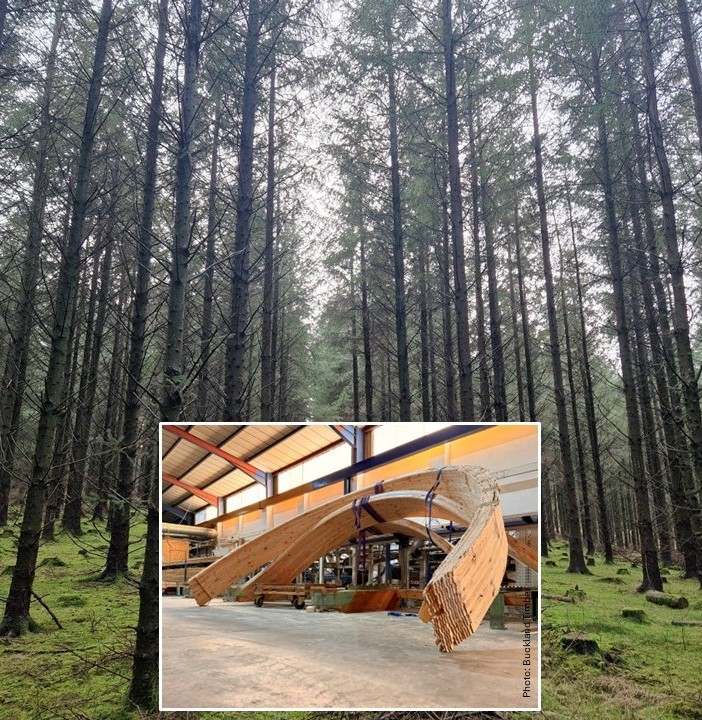
Glulam manufacturing image kindly supplied by Buckland Timber
